Old Trade, New Tools
Old Trade, New Tools
The rise of brand mascots in recent years has been well-documented, but for us, letting brand assets lead the way with communication is a legacy that continues.
There have been plenty of great articles recognising the popularity of mascots in the past few years, and it hadn't gone unnoticed that more of these projects are coming through our doors – both the creation of entirely new brand characters and the reinvention of heritage IP to appeal to younger audiences.
So when someone pointed out that Animade came out as a top suggestion for 'mascot animation' in an AI search, it got us thinking. Mascots are something we’ve always embraced; a theme echoing all the way back to our tiny Cowboy hero of Ready Steady Bang when we first started out.
So why are mascots big again?
Perhaps in the age of generative AI, a friendly face brings the sense of trust and reassurance that we instinctively crave on a human level. Nostalgia may also play a part. Ultimately though, for us, this character-led approach to branding sums up who we are creatively, at the core of Animade.
We have always been driven by character – whether that’s a figure with a face or a charismatic blob – as a way to connect with people, to bring joy and relatability. Our hearts are in the work that we do, and the characters we create carry that with them.
Bringing heritage mascots up to date
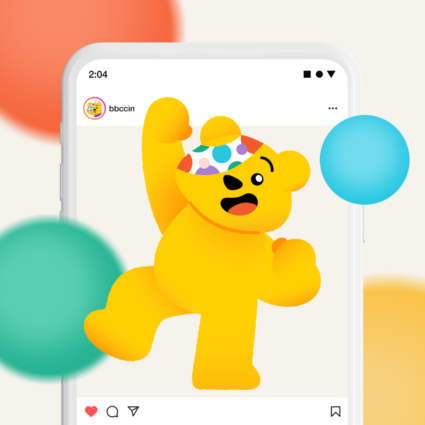
Pudsey Bear has been the mascot for BBC Children In Need since it launched over 40 years ago. When Wolff Olins asked us to refresh Pudsey’s design, we were conscious that working with a popular heritage character is about striking the right balance.
We wanted a new generation to connect with Pudsey, while continuing to build on the affection millions have had for him over the last four decades.
New dimensions
Cat treat brand Temptations had long used T-Cat as the mascot for their brand, however, up until recently, the character had always been a static illustration.
With agency Elmwood, the company focused on the potential of making him move as a surefire way to connect on an emotional level with their audience, truly bringing the brand to life.
Incorporating AI
Together with JKR, Walmart recently reclaimed the Smiley that was a major part of the brand’s identity in the 1990s with new AI shopping assistant Sparky, who brings the multi-national retailer right up to date with its responsive characteristics.
And of course its loveable charm.
Creating new characters to love (and bringing the sass)
One of the first things to consider when working with a brand mascot is the personality. Whether it’s strong and heartfelt like Pudsey, or impish and sassy like Gizmo, the motion has to bring out a character that people believe in.
Our latest mascot project comes in the form of an axolotl; the encouraging companion of AI studying tool Gizmo that taps into the younger generation with a mischievous streak it isn’t afraid to show.
The heart of brand identity
The central character we designed as part of the visual identity for It’s Nice That’s Extra Nice platform was featured in Mascot, a publication by Counter-Print exploring the use of mascots in contemporary design.
The simple blocky shapes, big hands and solid feet speak to the character’s utility and generosity – they stand firm as a kind, supportive character. But they are also inquisitive and welcoming, they love to express themselves, and they are utterly playful.
This is an area with so much potential, and while brand mascots are getting more exciting creatively as a space to play in – with the introduction of tools like AI and Rive – at the core, mascots are still about the one thing we’ve always believed in: the power of character.
Animade ©2026. All rights reserved.